I will never forget the first time I held a Paiute water basket. In 2013 I was standing inside a collection space in Riverside, California, trying to figure out what I wanted to write about for my master’s degree in public history. At the end of the day, all I kept thinking about is, “How did that small water basket from my homelands in Nevada end up in Southern California?” Determined to unlock the history of this piece, and that of its creator, I ended up focusing my thesis, and later my dissertation, on how Native American women and men in the early 1900s sold their baskets to provide for their families and as a way to keep this ancestral tradition from disappearing. Most importantly, I focused on how basket weaving is an exercise of patience, love and admiration.
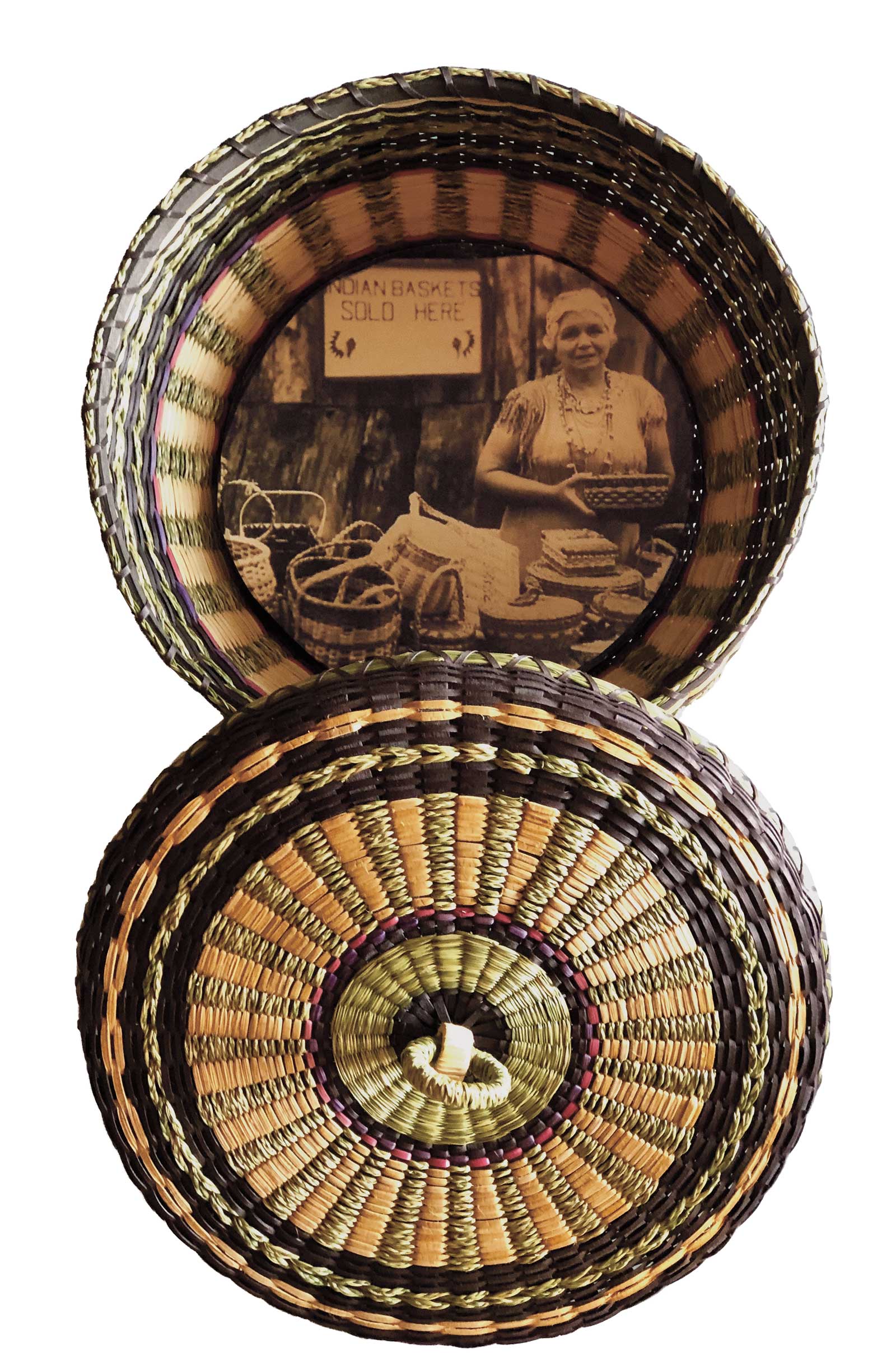 Theresa Secord (Penobscot), Commissioned Penobscot sewing basket with image of artist’s great-grandmother, Philomene Saulis Nelson, taken in 1953, made with ash, sweetgrass, cedar bark and commercial dye. Photo courtesy the artist.
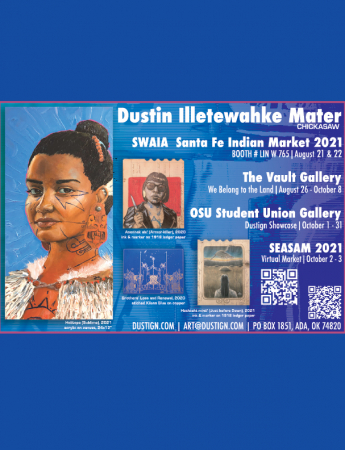
As I interviewed some of the basket weavers featured at this year’s Santa Fe Indian Market, I became aware of just how much marketplaces continue to be for basket weavers looking to express their sovereignty, as well as their own cultural values. For example, Theresa Secord (Penobscot) commented on how the featuring of her work at SWAIA’s annual market follows in the footsteps of her great-grandmother, Philomene Saulis Nelson, who sold her baskets on the Penobscot Reservation in the 1950s. Secord commented on how proud she is to come from a long line of women who could express the vibrancy of Wabanaki culture through the lens of basket weaving. In fact, one of Secord’s recent commissions is in the form of a Penobscot sewing basket, similar to the one held by her great-grandmother in a photo that rests on the piece’s base.
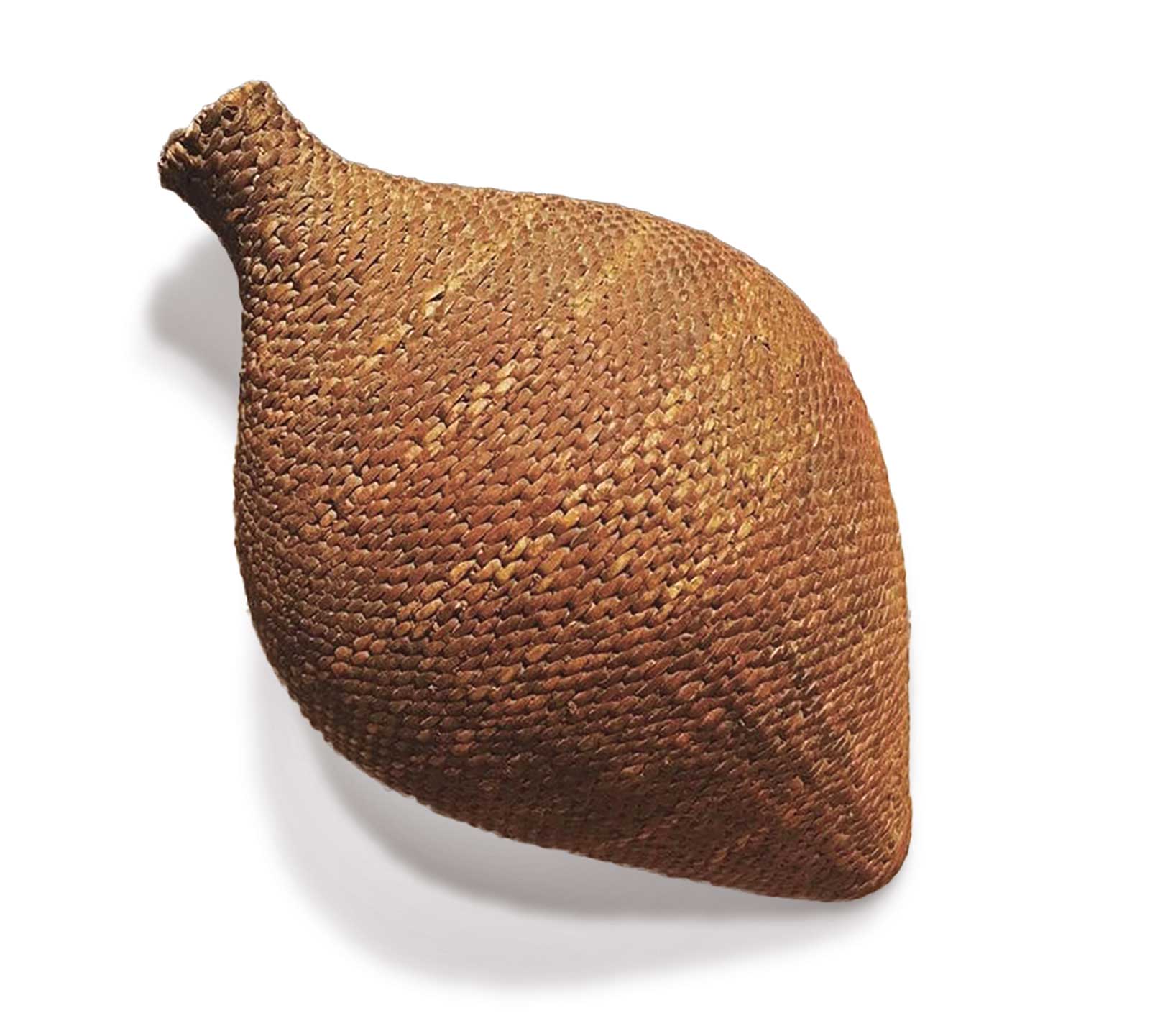 Paiute Water Basket,1900s. Photo provided by the author.
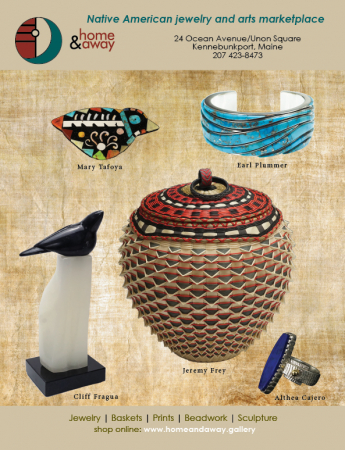
When talking to Jeremy Frey (Passamaquoddy), he similarly commented on how basketry is a family affair; he learned from his mother. Frey, who began to weave full time in 2002, says basket weaving is often a labor of love where he tries to maintain things from the past while also trying out new techniques, concepts and designs. Although initially criticized for his contemporary work by traditionalists, Frey argues that “everything that has ever been traditional was contemporary at one point in time.” I believe that Frey’s determination to create his pieces on his own terms, while simultaneously respecting the foundations of Passamaquoddy basketry, led him to win SWAIA’s coveted Best of Show in 2011. This success is why Frey tells up-and-coming artists not to be afraid to express themselves in the ways that they genuinely want to. You never know what works will win the most ribbons or who will be judging your work, but you do know if you are true to yourself, your story and your community.
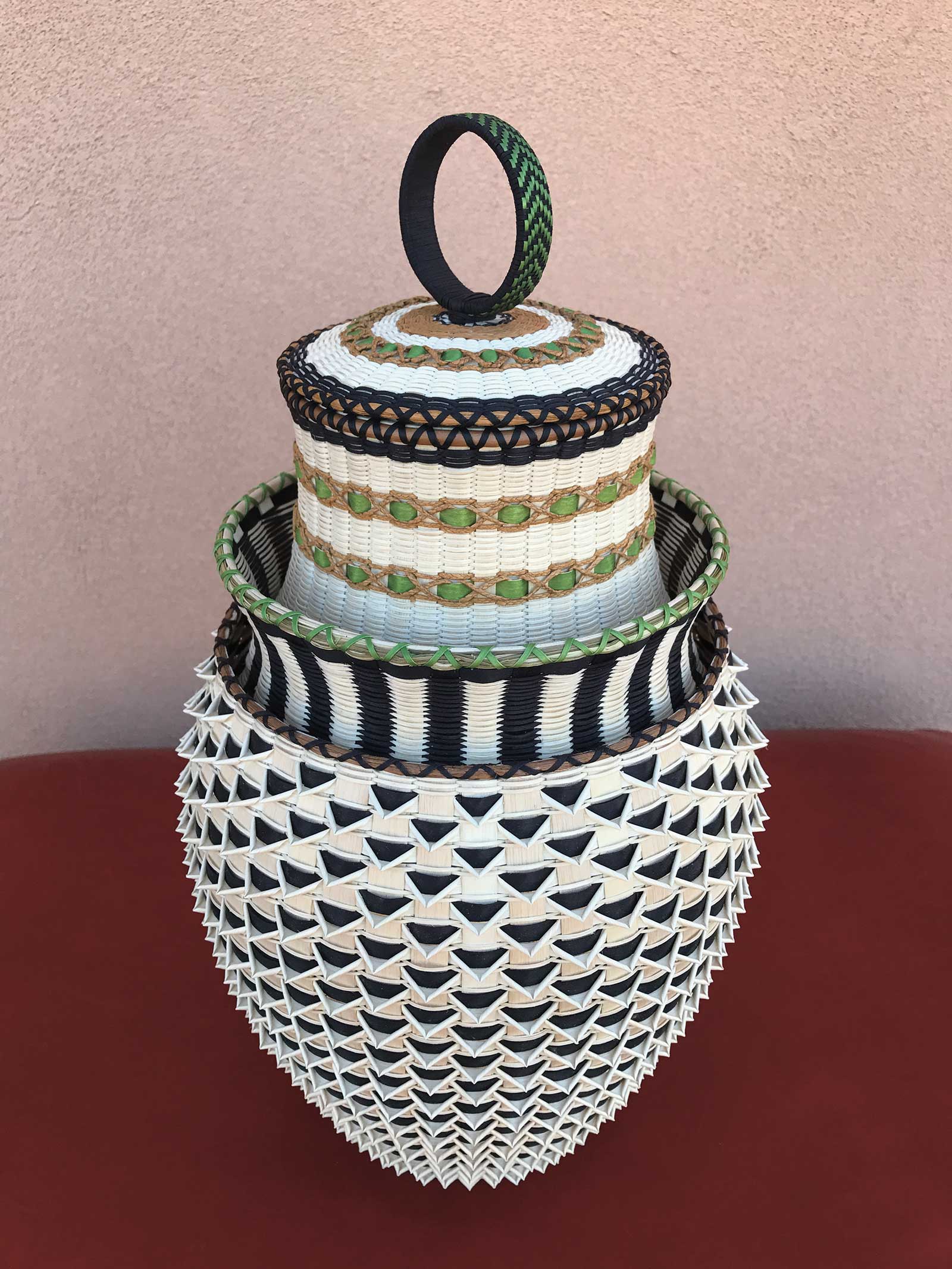 Jeremy Frey (Passamaquoddy), Time, black ash, sweetgrass, cedar bark and commercial dye. Photo courtesy the artist.
Reflecting on Secord and Frey’s words makes me think of how Indigenous artwork should not be separated from that done by our ancestors. They taught us how to utilize the resources around them, adapt to environmental changes and use one’s creativity to provide for those their loved ones. To me, hearing Frey speak about the evolution of his work made it easier to think about how his story and the love he has for his community, and this practice, is captured within every piece he creates. To be able to own a piece of his work is to be a part of a much larger narrative of basketry innovation and continuity.
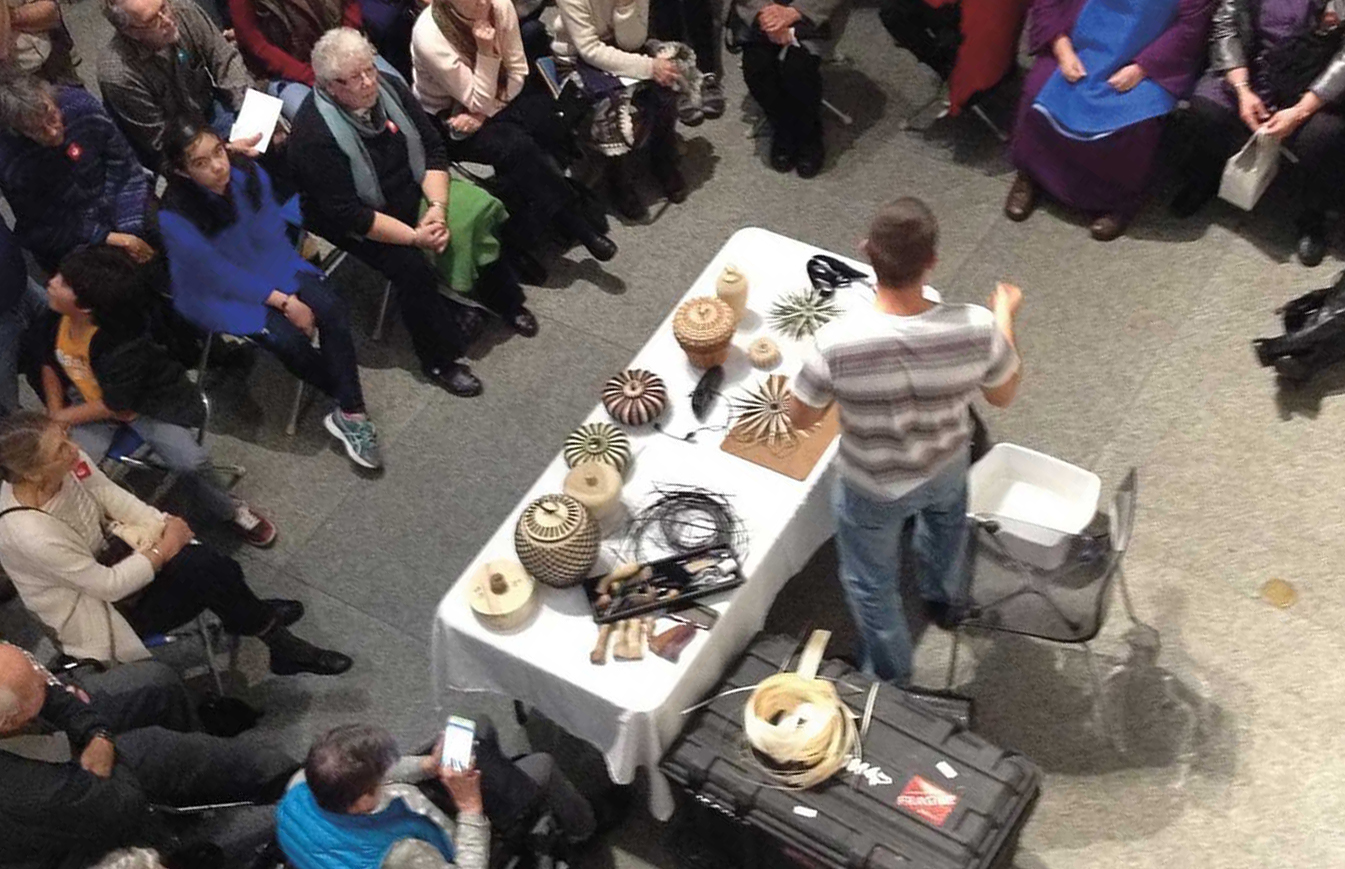 A crowd gathers around Jeremy Frey during a basketry demonstration. Courtesy the artist.
This sentiment is also true for the baskets created by Carol Emarthle-Douglas (Northern Arapaho/Seminole) and Don Johnston (Aleut). Douglas’ work reflects “Plain’s art forms, ledger art and beadwork of the Northern Arapaho; the designs, colors and patchwork from the Seminole Nation of Oklahoma.” What is the most striking about Douglas’ work is how she pays homage to the basketry techniques of many different Indigenous communities. For her 2015 Best of Show basket, Cultural Burdens, Douglas skillfully wove 22 women figures carrying tiny burden baskets on the outside and inside of the basket. According to Douglas, “This basket is a tribute to their mothers and women; they were the carriers of our culture, children, food, firewood and stories for their families. Each figure is a miniature version of their traditional technique and materials.” She accomplished this by conducting research and interviews with basket weavers of the featured communities. Through her artwork, basket weaver’s stories cannot be overlooked because she sings their praises and honors their histories.
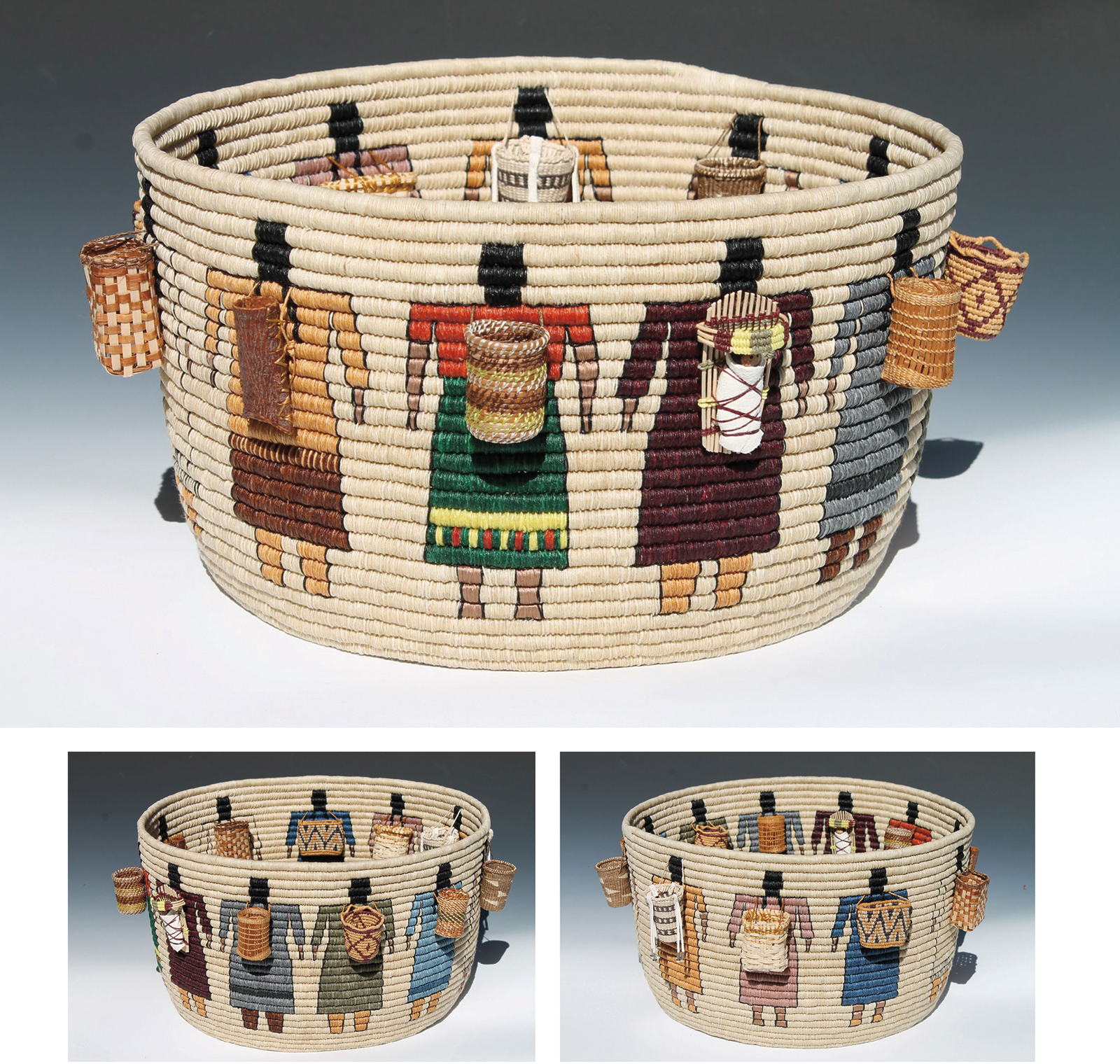 Carol Emarthle-Douglas (Northern Arapaho/Seminole), Cultural Burdens, 2015, imported Irish waxed-lined thread in various colors, hemp, round reed, flat reed, hickory splints, black ash splints, red cedar bark, yellow cedar bark, yucca, white oak bark, pine needles, silk thread, sinew, wood beads and deer hide. Photo courtesy the artist.
Johnston began his basket-weaving journey after a series of setbacks in Anchorage, Alaska. While walking in downtown Anchorage, he met James Omnik Sr., who was shaving baleen, the material found in the jaws of large whales, for baskets. That same day, Omnik began teaching Johnston the basics of this traditionally Inuit and Yupik practice. Johnston is not solely concerned with the story his baskets can tell; instead, he wants to ensure that he respects the whales and walruses for the materials they provided for him to make such beautiful pieces. He wants those who admire his works to walk away with this same level of respect. Doing so allows all of us to enjoy the beauty of Alaskan Native American heritage thoroughly.
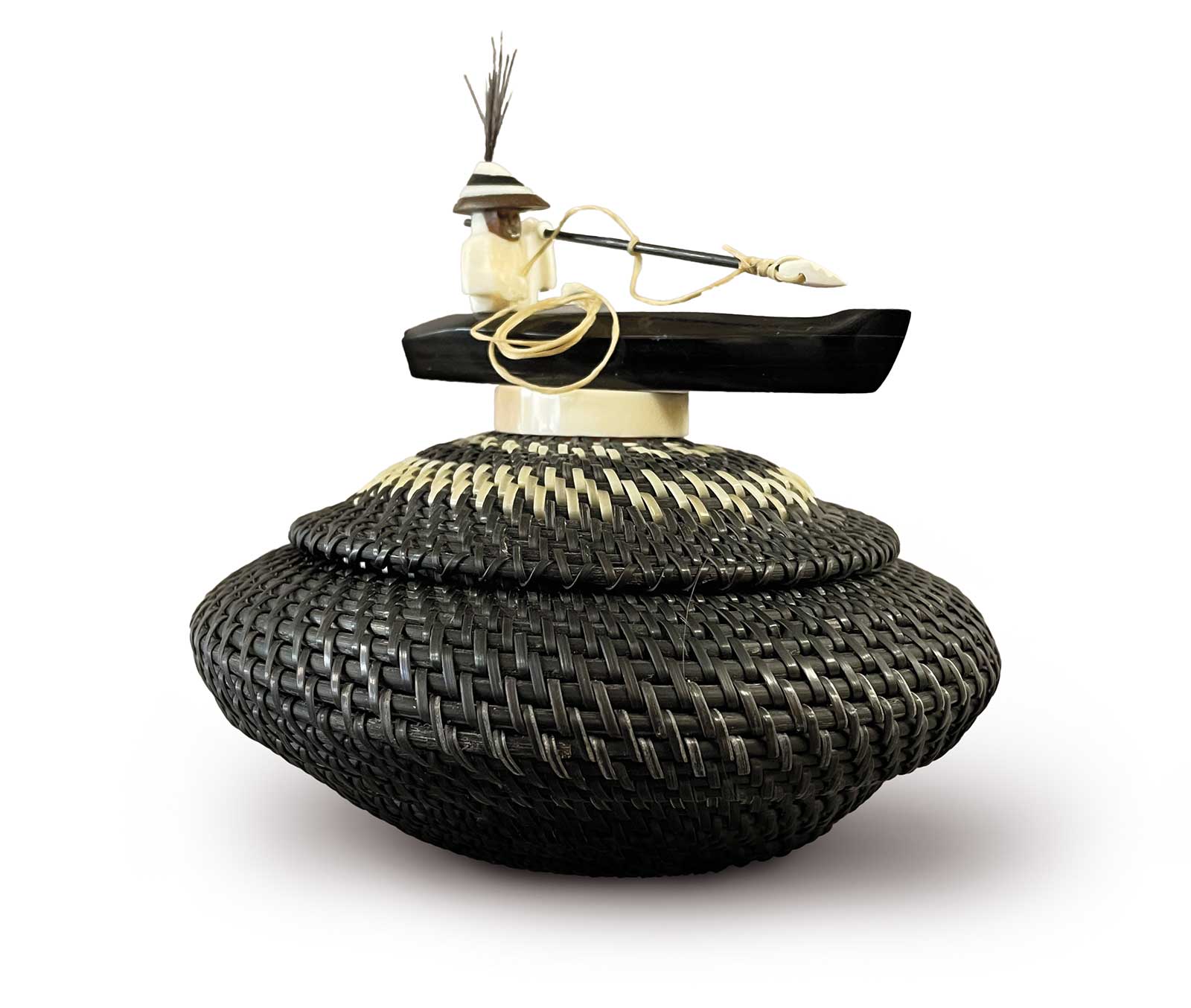 Don Johnston (Aleut), Baleen basket with Aleutian kayak finial, baleen, walrus ivory and white baleen, 6½ x 6¼ x 5¾". Photo courtesy of Don Johnston and Arctic Spirit Gallery.
Each weaver featured in this article not only honors their ancestors but they're also paving the way for the next generation of basket weavers. They are proving how vital basketry is, and always has been, to organizations like SWAIA. I remain grateful for their work and the lessons they teach each of us. I often look back at my experience in 2013 with a sense of admiration. I did not know where basketry would take me, but I am glad I decided to open my heart to their many stories, creators and splendor.
I hope those reading find this same level of admiration at this year’s market. I promise you will not
be disappointed.
Powered by Froala Editor